
Learning Intentions
By the end of the lesson you should be able to:
- Explain why we need to reference
- Identify APA 7 as the referencing system used at MLC
- Identify the required elements of a reference and create a correctly formated reference list
- Use in-text citations
- Use tools to create references including Citefast
What is referencing?
Why do reference?
- For honesty
- To give our writing credibility
- To allow people to follow up the sources
- To avoid plagiarism
(Reasons for referencing, n.d.)
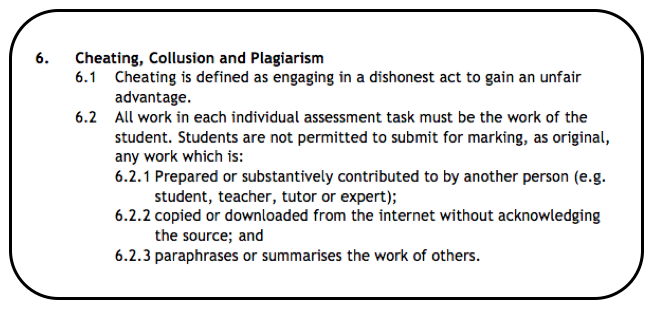
Here is an extract from MLC’s Assessment Policy. Pay particular attention to 6.2 and 6.2.2 and 6.2.3.
- It’s the law
Under the Copyright Act 1968, “the Law enables the person who created the material to have rights over what happens to it”(ACU, n.d.) and a creator has the moral right to have their work treated with respect and attributed to them as the owner of the work (Copyright Agency, 2022).
How do we create a reference list?
All reference list contains the following details about each source that is used in your work:
Author
Date
Title
Source details (i.e. where can source be retrieved? e.g. periodical/ publisher information, DOI or URL)
The format may change slightly depending on the style used and source type.
The MLC Referencing guide gives you the format for most common source types.
What system does MLC use?
- APA – 7th Edition
- Alphabetical order
- All the different resources are listed together in one list
* APA (American Psychological Association)
A basic book reference in APA – 7th Edition
Author, Initial. (Copyright year). Title of the book. Publisher.
Example:
Allen, J. (2017). What is the future of artificial intelligence? Reference Point Press.
Other basic formatting rules:
Organise the reference list in alphabetical order by the author’s surname.
Author’s surname comes first, followed by a comma then their initials.
If the item has no author, then use the title first.
Punctuation is important used –
The date of publication us in brackets (If there is no publication date use n.d. in it’s place).
Fullstops are used between each element of information (except not at the end of a URL).
Use a space after each punctuation mark.
Titles are in italics.
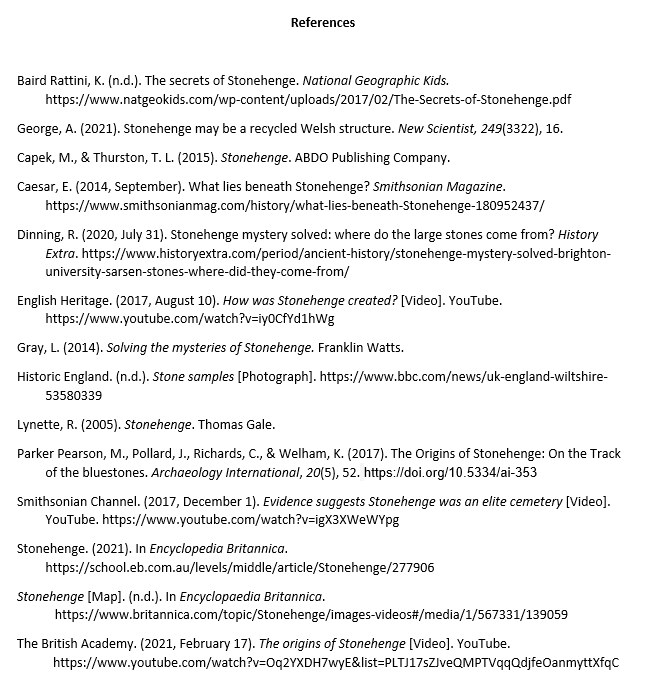
If your citation goes over a line, you must use a hanging indent. (CLICK HERE on how to create a hanging indent in Word)
In-text citations
Watch the following video to find out about in-text citations.
Direct Quotes
You will need to include the author, year of publication and page number (preceded with p. if possible).
Parenthetical examples:
1. With an introductory sentence
Within a decade a significant proportion of jobs that exist today in Australia will be replaced by automation: “21% of physical jobs and 28% of location-based jobs will disappear by 2030” (Higgins et al, 2021, p.13).
2. Incorporated into your own sentence
Due to automation, artificial intelligence and physical robotics it is predicted that “21% of physical jobs and 28% of location-based jobs will disappear” in Australia by 2030 (Higgins et al, 2021, p.13).
Narrative example (the author is part of your sentence)
3. With an introductory phrase
A recent study by Higgins et al (2021, p.13) predicts that “21% of physical jobs and 28% of location-based jobs will disappear” in Australia by 2030.
Click here for more on direct quotes and how to cite them (from scribber.com)
Paraphrasing
Paraphrasing is putting someone’s else’s words into your own words and is an alternative to a direct quote.
To avoid plagiarism, paraphrasing also requires you to cite your source using an in-text citation (Scribbr, 2022).
Click here for more on how to paraphrase and how to cite a paraphrase (from scribber.com)
Practice
You Turn
Worksheet 1: Identify In-text citations. Open this student sample (Word document) and follow the instructions to identify the in-text citations.
Worksheet 2: Citing a source. Practice writing in-text citations using a direct quote and paraphrase.
Where to get further help
Where can I get help with my referencing?
From the Library
- MLC Referencing Guide (This can be downloaded and stored on your device)
- Teacher Librarians
- Use the Online Catalogue and databases to make reference lists for you
APA website
Scribbr website
How to Cite in APA Format (7th edition) | Guide (scribbr.com)
Free citation generators (Scribbr and Citefast are two that are recommended)
You can create a free account for either of these tools to save your reference lists and to create multiple lists.
Check In
What is one new thing you have learnt today?
- Moral rights – Copyright Agency – update
- Correct APA format [Image]. (n.d.). http://yelom.myphonecompany.co/correct-apa-format/
- Higgins, S., Meena, S., & Gownder, J.P. (2021, February 22). Future Jobs: Australia’s Automation Dividends And Deficits, 2020 To 2030. https://www.parliament.nsw.gov.au/lcdocs/submissions/70815/0044%20Forrester%20Research%20Inc.pdf
- Leeds University Library. (2009). References and citations explained [PowerPoint slides]. http://skills.library.leeds.ac.uk/lecturer/referencing/workshops/referencesandcitationsexplai ned.ppt
- Reasons for referencing. (n.d.). http://www.hawkerc.act.edu.au/__data/assets/pdf_file/0007/268891/3_REASONS_FOR_REFERENCING.pdf
- University of Southern Queensland. (n.d.). Referencing. http://www.usq.edu.au/extrafiles/ltsu/templates/ltsu_templates/referencing.htm