
Year 10 Science
Climate Solutions
Last updated 11 September 2019
If you have any questions or requests for assistance regarding your research, please contact your Teacher Librarians.
This page has been created to support Year 10 Science students with their inquiry task on climate solutions.
Use the following process to help you work through this task.




Questions to ask yourself:
- What do I need to do?
- What do I need to find out?
Strategies you can use at this stage:
- Understand the instructional words in your task
- Highlight the keywords in your task
-
- watch this video to help identify keywords
- use Thesuarus.com to find alternative keywords
-
- Define any words you don’t know
- try Dictionary.com to define any words
Questions to ask yourself:
- Where can I find the information I need?
- What search tools, sources and equipment can I use?
- Which sources best suit my needs?
Places to search at this stage:


Select your topic from the lists below to see what is available on the catalogue.
Contact Mrs Bakitch if your topic does not appear here.
Important Concepts
Climate Change and the Asia Pacific Region
This article looks at the Drawdown book and looks at the most effective strategies suggested. This might be useful for background reading.
Roberts, D. (2017). This book ranks the top 100 solutions to climate change. The results are surprising. Retrieved from https://www.vox.com/energy-and-environment/2017/5/10/15589038/top-100-solutions-climate-change-ranked
Transport
Women and Girls
Land Use
Materials
Coming Attractions
Questions to ask yourself:
- Which of these resources will be of use to me?
- Which information will I really use?
- Can I understand the information I have found?
- How credible/ reliable is the information I have found?
- How relevant is the information I have found to my current information need?
Strategies for this stage:
If you use the free internet make sure you use the CRAAP test to evaluate the information before you use it.
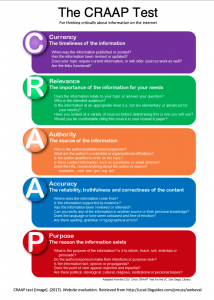
 The most important criteria to apply first to any sources is the authority. Does the person have the experience or qualifications to write the information? If not, it’s probably not the best information to use.
Watch the following video on how to apply the CRAAP Test.
Questions to ask yourself:
- How can I organise this information to solve my problem/ complete my task?
- Have I:
- made notes under my focus questions or organised my notes to match them?
- recorded details of my sources of information for my Reference List/ Bibliography?
- Do I have enough information?
Strategies for this stage:
- Select a suitable note making method of recording the information you find.
You can either use ones we recommend from our site
OR
Use a collaborative document like Word via Office 365 that everyone can work on and add to.

- Write down where you got your information from in a Reference List/ Bibliography.
Use Citefast to record your sources as you go.

Questions to ask yourself:
- How can I best present this information to communicate it with other people?
- Who will be my audience?
- Which would be the best format? (Have I been given instructions about this?)
- Have I included everything I need to communicate?
Strategies for this stage:
- Choose a presentation style for the intended audience and the purpose of the task.
As you will be doing a class presentation in groups, you need a tool that will allow collaboration. The best tools for this include:
 PowerPoint via Office 365
 Keynote


- Watch the following short video on how to create the most effective presentations.
Questions to ask yourself:
- Did I achieve my purpose?
- What did I learn?
- How did I go with:
- Each step of the process?
- Presenting the information?
- What would I change if I did the task again?
Strategies for this stage:
- Reflect on how well you went with your task based on your teacher’s feedback.
- Set some goals on how you will improve for next time.
References
Checklist [Image]. (n.d.). Retrieved from https://www.trade-city-award.eu/eligibility-criteria.html
Climate change [Image]. (n.d.). Retrieved from https://www.unenvironment.org/explore-topics/climate-change
Information skills process [Image]. (n.d.). Retrieved from https://macfields-h.schools.nsw.gov.au/learning-at-our-school/information-resource-centre.html