
Year 10 Economics & Business
Hypothetical Economy
Important Terms
Economic growth rate
An economic growth rate is the amount of change in a country’s GDP from one year to another written as a percentage.
Changes in economic growth can be a positive or negative number. A postive number will show growth in the economy, a negative number will indicate that the economy is shrinking.
Fiscal policy
Fiscal policy is the government’s management of the federal budget, where they adjust spending and tax rates to influence the performance of the economy.
Government spending
If a government wants the economy to grow, it will increase spending for goods and services. This will increase demand for goods and services. Since demand goes up, production must go up. If production goes up, companies may need to hire more people. People that were once unemployed may now have jobs and money to spend on goods and services.
If the government thinks the economy is overheating – or growing too fast – the government may decrease spending. A decrease in government spending will decrease overall demand in the economy. Businesses will slow production, which means profits will decline, resulting in less hiring and business investments.
Government spending allows government to provide:
- Public goods
- Merit goods – a good or service that is regarded by the society or government as deserving of public finance e.g. education, health etc.
It also provides state welfare support for low income households and/or the unemployed.
Government spending is also a means of redistributing income within society e.g. to reduce the scale of relative poverty
Taxation
Taxation is required by any government in order to:
- Raise revenue – to finance government spending
- Change the distribution of income and wealth – to make it more equal
- Address market failure and environmental targets – taxes may help correct market failures
Watch the following video for more information about fiscal policy.
Gini coefficient
The Gini index is the most widely used measure of inequality. It looks at the distribution of a nation’s income or wealth.
A score of 0 means that all individuals have the same income and therefore everyone is equal.
A score of 1 means that a single person has all of the income and there is extreme inequality.
Therefore, the closer a country’s score is to 0, the more equality there is in that country.
To see the latest figures, visit the World Factbook page.
NOTE: To see how your country compares to those on the list, you will need to multiple the Gini coefficient by 100 to get a similar figure.
Gross Domestic Product (GDP)
GDP is the sales value of all final goods and services produced in the economy during a single year. This can be shown by the following formula:
GDP = consumption + investment + government spending + (exports – imports)
Watch the following video for more information about GDP
Human development index ranking
The Human Development Index is a way the United Nations Development Programme measures well-being within a country.
The Human Development Index was created to recognise that people and their capabilities should be the ultimate criteria for assessing the development of a country, not economic growth alone.
This index takes into account the following aspects:
- a long and healthy life (life expectancy at birth),
- being knowledgeable (schooling), and
- having a decent standard of living (gross national income per capita).
Each of the 170 countries and territories included are given a score between 0 and 1. The closer a country scores to 1, the higher the quality of life for its citizens. These scores are then put in order from highest to lowest and each place is assigned a number. To see the rankings of various countries around the world visit the International Human Development Indicators page.
To see the latest rankings, visit the Human Development Index and its components page.
Watch the following video for more information about the Human development index ranking
Inflation
Inflation is when the general level of prices paid for goods and services over a certain period of time increases.
Inflation is good when it is mild as it can help the economy grow. When prices are going up, people will buy now rather than pay more later. This increases demand in the short term. As a result, stores sell more and factories produce more now. They are more likely to hire new workers to meet demand. It creates a virtuous cycle, boosting economic growth.
In Australia, the Reserve Bank of Australia (RBA) aims for an inflation rate of 2-3%.
Watch the following video for a more detailed explanation.
Labour force participation rate
The labour force participation rate measures the percentage of the population of working age who are either working or looking for work.
Watch the following video for a more detailed explanation.
This video explains why participation rates change over time.
Monetary policy
Monetary policy is undertaken by a central bank of a country. In Australia, this is the Reserve Bank of Australia. It involves using interest rates and other monetary tools to influence the levels of consumer spending and demand. In particular, monetary policy aims to stabilise the business cycle – keep inflation low and avoid recessions.
Reserve Bank (RBA)
The Reserve Bank of Australia (RBA) is Australia’s central bank.
The RBA’s role is to:
 Try and keep inflation under control
This is monetary policy and is mainly done by adjusting the cash rate. This is done 11 times a year and announced on the first Tuesday of each month except January. The cash rate is the interest rate that banks pay to borrow funds from other banks in the market. This figure helps the banks to decide what interest rate they will charge us for borrowing money from them and how much interest they will pay us for the money in our bank accounts. If the economy is going well, the cash rate and therefore interest rates will be higher to stop the economy growing too quickly and making the rate of inflation too high.
 Print plastic money
The RBA is responsible for designing, printing, issuing, circulating and destroying Australian bank notes, but has no control over coins.
 Oversee the payment system
The RBA is also responsible for managing the computer system that banks use to transfer non-cash payments between themselves. Anytime you buy something using a card instead of cash, you are using this system. When a digital payment, like an eftpos or credit card, occurs between a buyer and seller who are customers of different banks, money needs to move between the banks to make the payment successful.
 Act like a regular bank
The RBA is the government’s bank. When a person receives a refund from their tax return or money back from Medicare, which are government department’s, this money actually from an account at the RBA.
 Promote financial stability
It does this by warning the general public of economic risks through speeches, advises the government and regulators on how to protect against these risks, and works with international organisations on the setting of global rules
Watch this short video about the RBA and its role in our economy.
Unemployment rate
The unemployment rate is the percentage of the labour force who are out of work but actively looking for employment.
Even a healthy economy will have a level of unemployment because workers are always coming and going, looking for better jobs. These jobless people, until they find a new job, are part of the natural rate of employment.
Watch the following video for more information. Be aware that is it American. For information on how Australia calculates the unemployment rate, see below the video.
In Australia, the Australian Bureau of Statistics (ABS) provides the data for the unemployment rate. They do this by sending out the Labour Force Survey to thousands of households each month.
Here is the criteria, Australia uses to find the unemployment rate.
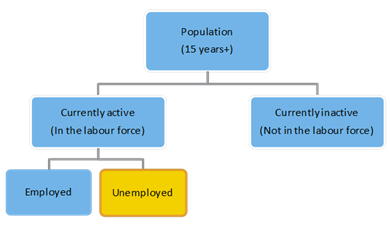
For a person to be included in the unemployment rate they must be:
- over the age of 15
- available for work (this means they can’t be in prison, health facility, or already employed)
- currently looking for work