Year 10 Economics & Business
Hypothetical Economy
What is the business cycle?
The business cycle is the natural rise and fall of economic growth that occurs over time. The business cycle uses the changes in gross domestic product to measure the economic growth. Sometimes it is called the economic cycle.
One cycle is one complete movement of the economy from peak to peak or trough to trough. Business cycles are not equal in length. In the United States, the:
- Shortest was around 17 months (1920-1921)
- Longest was around 128 months (1990-2001)
When the data, from a given time period, is placed on a graph it will look something like the diagram below.
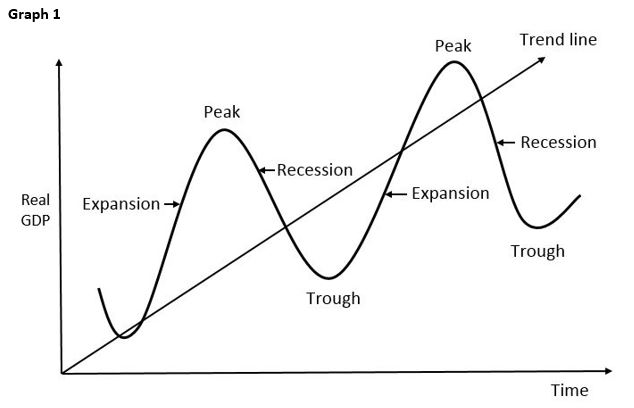
(Higher Rock Education and Learning, n.d.)
In the diagram you can see that even though there are ups and down in the economy, the straight line shows that the economy is still moving in an upwards direction overall e.g. growing.
Watch the following video for a more detailed explanation of the business cycle.
Peak / Boom
The height of the expansion phase
Contraction / Recession
Trough / Bust
The lowest point of the contraction phase
Expansion

Interest rates
- Climbing
- Falling
- Lowest rates
- Starts to rise after a long time
Stock prices
- Climbing
- Stock prices begin to fall
- Falling
- Rising, perhaps rapidly
Consumer confidence

- Strong confidence in the economy
- Decline in consumer confidence
- Lowest confidence
- Rising levels
Consumer spending

- High levels of consumer spending
- Consumers spend less and save more
- At its lowest
- Consumers begin to increase spending again especially on expensive items
Industrial production
- Rises to its highest point
- Cut back on production capacity
- At it’s lowest
- Growing
Housing construction

- Highest number of new homes being built in the cycle
- Less new homes are being built
- Lowest level of new homes being built during the cycle
- More new homes begin to be built
Business investment
- Firms will only invest if they are confident about future demand for their product. An optimistic view of the future leads to investment in stock.
- On the other hand, pessimism about future prospects will lead to low investment with a danger of creating a downturn in the economy.
- Pick-up in demand for capital goods to meet strong consumer demand
- Business start to cut back on investment due to lower levels of consumer confidence and spending
- Less finance available – banks being more cautious who they lend money to
- Weak investment due to lowest levels of consumer spending and confidence
- Less finance available – banks being more cautious who they lend money to
- Businesses start to feel more confident and start to invest again.
Business profits
- Higher profits
- Lower profits
- Lowest level of profits in the cycle
- Profits start to increase
Unemployment rate

- More jobs created
- Falling unemployment rate
- Higher real wages
- Rising unemployment rate
- Fewer job vacancies
- High levels of unemployment
- Natural rate of employment may be around 4-5% anyway
- The rate starts to decrease.
Government revenue

- Rises as people earn and spend more and companies make larger profits
- Government can increase spending in areas like education, the environment, health and transport
- Tax revenues falling
- Welfare benefit rising
- Falls
- Starts to increase again as people spend and earn more money
Imports & exports
- High demand for imports as economy cannot supply all of the goods and services
- Drop in the value of exports and imports of goods and services
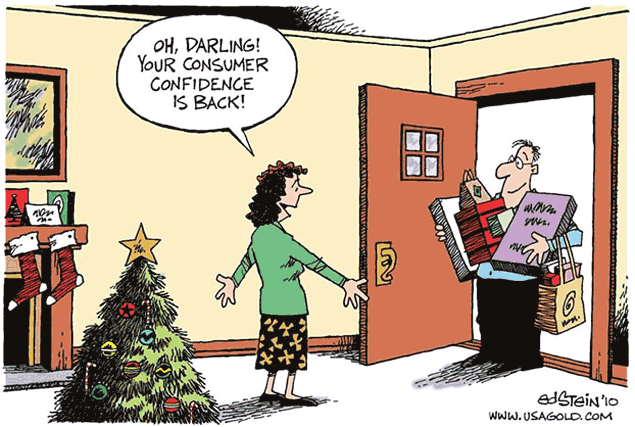
(Stein, n.d.)
Changes in the level of business and consumer confidence
When consumers are confident, they buy now. They know there will be future income from better jobs, higher home values and increasing stock prices. As demand increases, businesses hire new workers. The increase in consumer income, further stimulates demand. A little healthy inflation can trigger demand by spurring shoppers to buy now before prices go up.
On the other hand, if consumers are worried because they might lose their jobs or prices might increase too much they will stop buying anything but necessities. Businesses will lay off workers, and hoard cash.
Changes in the value of consumer spending and business investment
This is what happens when consumers and businesses increase their spending and investment.
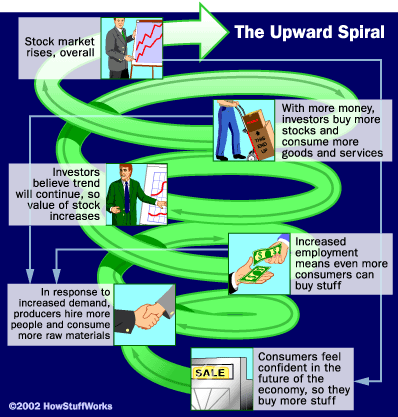
This is also called the inflationary spiral and happens during the expansion phase of the business cycle.
This is what happens when consumers and businesses decrease their spending and investment.
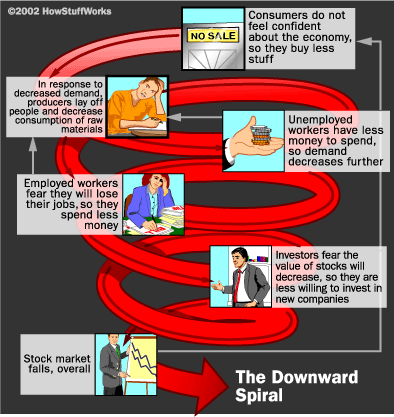
This is also called the deflationary spiral and happens during the contraction period of the business cycle.
Changes in government policy which can influence changes in the economy
Governments make many policies that can either intentionally or unintentionally influence the economy.
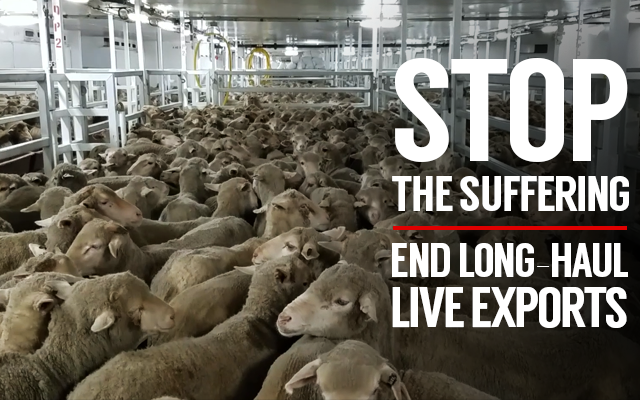
At the moment the Federal Government is considering banning live sheep exports to address the issue of the humane treatment of the animals not for economic reasons. If this goes ahead, the agriculture part of the economy will lose money from the sale of live sheep but new opportunities for the export of fresh or frozen meat may become available. Both of these would be unintentional impacts of the policy.
Governments make intentional changes to economy using fiscal and monetary policy.