
Note-taking for research
Notetaking = Information in your own words.
Effective note-taking is an important part of the research process.
What is note-taking?
Note-taking is a strategy used to extract the key pieces of information from material you have read, viewed or listened to, and record it in an organised and abbreviated way.
It may be tempting to copy and paste chunks of text from a website, but note-taking helps you to put the information into your own words.
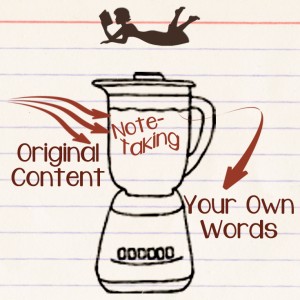
(Blender, n.d.)

(Note-taking, n.d.)
Why is it important to be able to write good notes?
- To help you gather information on a topic (part of the research process).
- To help you organise information to suit the structure of your task
- To help plan your writing and write in your own words
- To help you avoid plagiarism
Note-taking is also used as a study strategy to help you revise and study for test and exams.
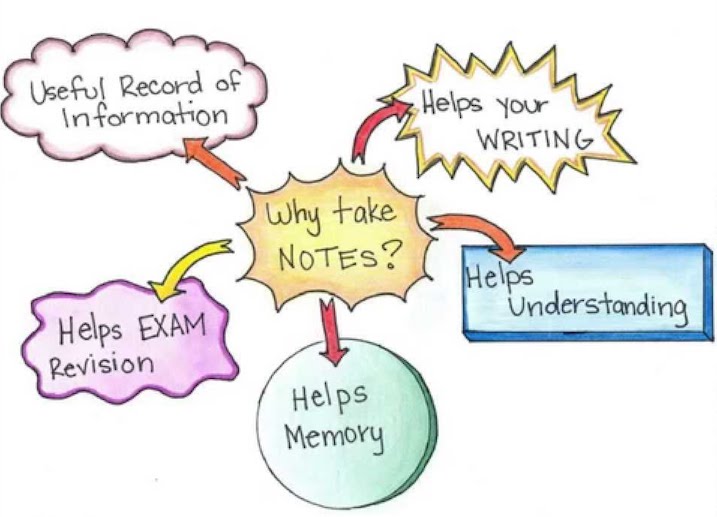
(Why take notes, n.d.)
How do you take notes?
When reading information from a text try the following:
1. Skim for an overview
- Quickly read the text passage to get an overview
- Look for heading and subheading
- Look for the important facts/ key points (in each paragraph)
- Look for keywords (in each paragraph)
- TIP: You may find it helpful to highlight/ underline these parts – if the text is your copy.
2. What to write down
- The topic – the main idea of the paragraph
- Important details from each supporting sentence
- Keywords/ phrases (in each supporting sentence)
3. How to write notes
- Use dot points (no need to write full sentences)
- Abbreviations where you can, e.g. info. for information
- Symbols, e.g. + $ CLICK HERE for more abbreviations
- Organise notes clearly
- Use a graphic organiser (see note-taking methods)
(Quill & Townsend, 2009).

(Highlighting notes, n.d.)
Note-taking Methods
Method 1: Outline Method
Uses headings and bullet points to organise information.
Each section starts with a heading of the main topic.
Subtopics and supporting details are indented and written underneath the heading.
Try using a numbered outline where appropriate to organise the information.
Leave spaces between sections or main ideas.
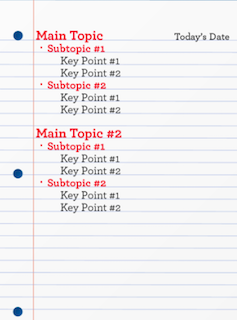
(Outline method, n.d.)
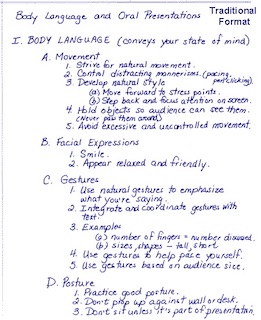
(Example notes 2, n.d.)
Method 2: Mapping Method
A visual way to organise your notes. It is similar to mind mapping.
Place your main topic in the centre and connect the key points (sub-topics) around it with branches leading out to supporting details.
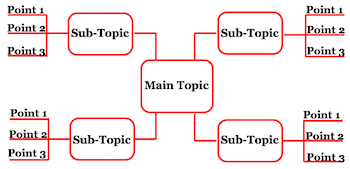
(Map method, n.d.)
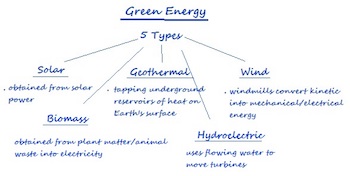
(Map method, n.d.)
Method 3: Cornell / Linear Notes
Uses 2 columns.
- Cue/ headings/ keywords/ questions in the first column
- Main notes in the second column
Linear Notes template
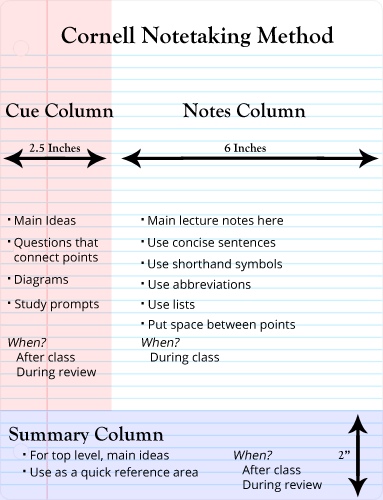
(Cornell notes 1, n.d.)
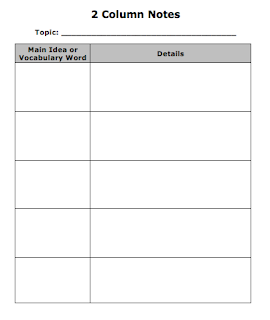
(2 column notes, n.d.)
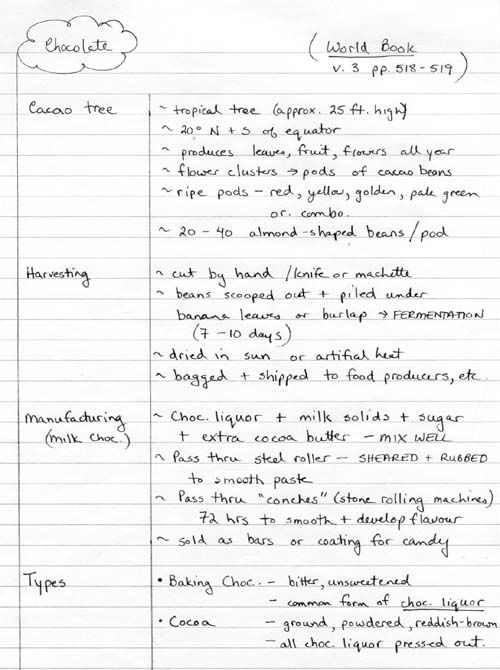
(Example notes 1, n.d.)
Write a summary
At the end of your notes it is always a good idea to write a summary to help make sure you understand the topic.
A summary is a brief statement in your own words of the main points you have noted.
Tips:
- Rule a line under your notes and write your summary underneath.
- Only use your notes to help you.
(Main ideas, n.d.)
For more note-taking help…
- Study Vibe – Notemaking
- Library website – Inquiry Support
- StudyVibe website – The Research Safari – Notemaking
Reference List
Blender [Image]. (n.d.). http://www.risking-failure.com/2013/12/note-taking-a-blender-for-your-brain.html
Cornell notes [Image]. (n.d.). https://pdf.wondershare.com/mobile-app/cornell-note-taking-system.html
Example notes 1 [Image]. (n.d.). http://davidhowald.com/two-column-notes-template/two-column-notes-template-lovely-23-two-column-notes-template-a%C2%9C%C2%88-two-column-notes-template/
Example notes 2 [Image]. (n.d.). https://msliewsclass.weebly.com/outline-method.html
Example notes 3 [Image]. (n.d.). http://blogs.luc.edu/hubbub/uncategorized/methods-for-good-notetaking/
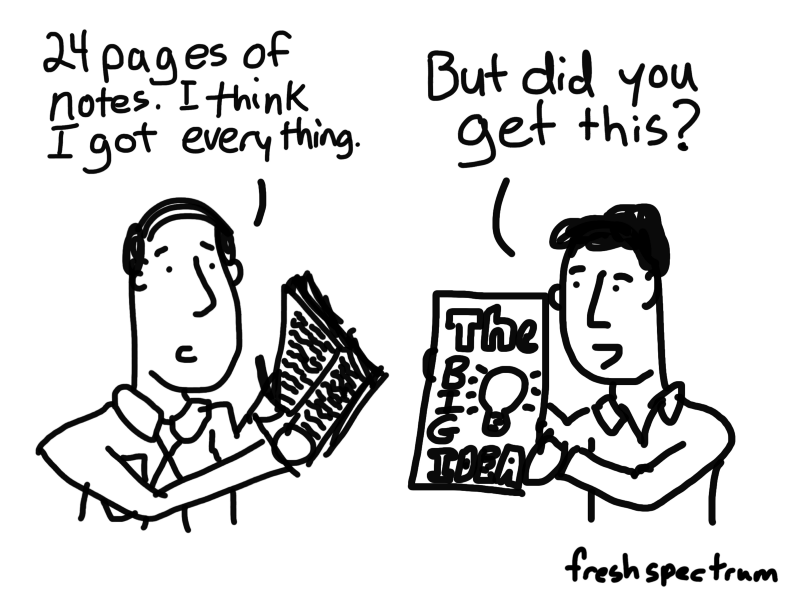
Fresh spectrum. (n.d.). The big idea [Image]. https://medium.com/@steveturnbull/how-do-you-take-notes-a-noteworthy-survey-b808af4b3c57
Highlighting notes [Image]. (n.d.). https://twitter.com/cadburycollege/status/961977994809094146
Main ideas [Image]. (n.d.). https://academichelp.net/academic-assignments/essay/write-summary-essay.html
Map method [Image]. (n.d.). https://www.testprepchampions.com/2017/07/effective-note-taking-strategies.html
Notes [Image]. (n.d.). http://www.arbeckert.com/20160218/the-five-pillars-of-healthy-writing/
Note-taking [Image]. (n.d.). https://www.lynda.com/Business-Skills-tutorials/Note-Taking-Business-Professionals/373782-2.html
Outline Method [Image]. (n.d.). https://www.oxfordlearning.com/5-effective-note-taking-methods/
Quill, A., & Townsend, A. (2009). Think, organise, write: Turn thinking into writing using graphic organisers. FarrBooks.
Roads to success. (2010). Study Skills. https:// cfww.com https://cfwv.com/images/wv/pdfs/rts/Facilitators_Guides/grade_7/G7_Unit4_StudySkills.pdf
Why take notes [Image]. (n.d.). http://athenasguide.blogs.brynmawr.edu/2015/08/10/tips-for-note-taking/