
Referencing for Teachers Made Easy
The Importance of Referencing
Definition:
Acknowledging sources of information, ideas and research used in academic work.
A set of instructions to know what order to put the information into.
Other terms:
-
- Bibliography
- Cite
- Citation
- Attribution
Role in academic writing:
• Give credit to authors and creators for their intellectual property
• Demonstrate academic honesty and ethical behaviour
• Allow readers to locate and consult the original sources
• Support claims, arguments, and evidence presented in the work
• Demonstrate depth and breadth of research
• Helps to avoid plagiarism and it’s consequences
APA Citation Style Basics
Introduction to APA
MLC uses the American Psychological Association (APA) citation style.
Guidelines for citing various sources of information in a consistent manner
The Four Key Components:
-
- Author(s): The person(s) or organization(s) responsible for creating the work
- Date: The year of publication or creation
- Title: The title of the work being cited
- Source: The publication information or retrieval details for the work
Examples of common formats:
-
- Books: Author, A. A. (Year). Title of book. Publisher.
- Journal articles: Author, A. A. (Year). Title of article. Title of Journal, volume(issue), pages.
- Websites: Author, A. A. (Year, Month Day). Title of web page. Site name. URL
In-text citations vs. reference list entries
-
- In-text citations: Brief citations within the text that refer to a specific source; includes the author’s last name, the publication year, and the page number(s) if applicable, e.g. (Smith, 2020, p. 12).
- Reference list entries: Complete citations for each source mentioned in the text, listed alphabetically at the end of the paper; provides all necessary information for readers to locate and consult the original sources.
Alignment to ICT General capability
Referencing skills are aligned to the Australian Curriculum
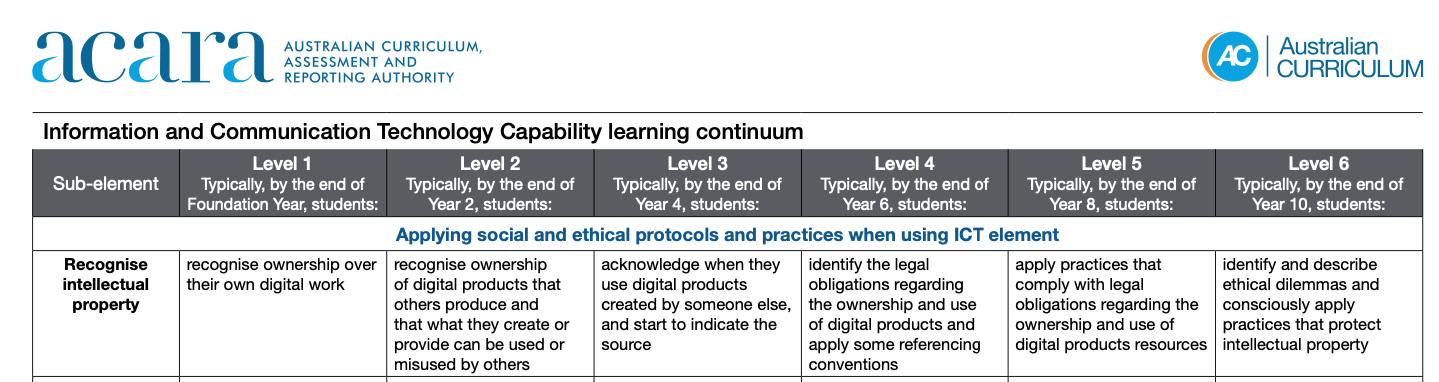
The following guide is a suggested map of APA citation skills aligned to the ICT General Capability to use with students when they are creating a piece of work that has required them to use the work of others in their research:
Referencing at MLC Continuum – Teachers Guide.pdf
(To access, use your MLC password if prompted)
Consider which classroom activities/ assignments where you can integrate referencing skills and assess students’ understanding and application of proper citation techniques in line with the ICT Capability learning continuum.
Teachers should expect students to submit a reference list (bibliography) for any substantial research assignment.
Seek assistance from MLC Teacher Librarians if you require some support.
Citing ChatGPT
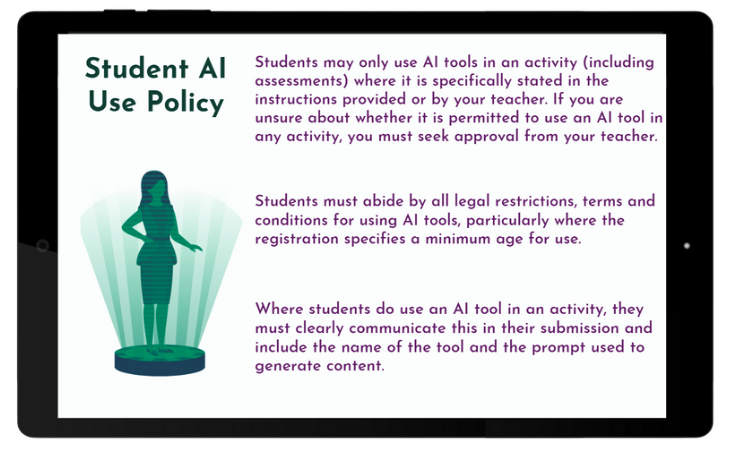
Students must check with their teacher first if they are permitted to use AI tools in an activity. If approval is given by the teacher, then students must communicate this in their submission and include the name of the tool and the prompt used to generate content.
How to cite AI generative tools?
Note: The following is related to the use of ChatGPT for research-based learning, i.e. using ChatGPT to gather information, answer an inquiry focus question. For this type of use and any other use, teachers may also like to consider having students submit a declaration where student provide details on how the AI tool has been used in the assignment (i.e. idea generation, research, structure, writing). See the example from Curtin University HERE.
In addition to academic integrity issues, when referencing ChatGPT there is an absence of traditional authorship and publication information with AI-generated content, making citing it in academic work rather complex.
ChatGPT – As responses from a ChatGPT “chat” is unretrievable, it is currently widely considered to reference ChatGPT as personal communication. However, as the communication isn’t with a person, according to APA (McAdoo, 2023) it should be treated as though the creator of the AI model is the author, and citing it like software is considered appropriate.
At MLC?
The expectation for referencing ChatGPT and other AI tools at MLC is still to be finalised. Here is a recommendation being put forward. It is subject to change as guidance continues to evolve.
Year 7 & 8 – Include an end-text reference list & attach the full-text response (i.e. screenshot) from the AI tool after the referencing list.
Referencing Format:
Author of AI Model used. (Year of AI model used). Prompt Description. Name of AI model used (Version). URL of the AI model used.
Example:
OpenAI. (2023). Prompt, ‘How was Stonehenge built?’ ChatGPT (Mar 14 version). https://chat.openai.com/
Year 9 -12
1. Include an in-text reference. Example:
When prompted with “What are man-made causes of salinity in agricultural land in Australia?” the ChatGPT-generated text indicated that there are several man-made causes including land clearing and inefficient irrigation and soil management practices (OpenAI, 2023).
2. Include the end-text reference
Open AI. (2023). Prompt, “What are man-made causes of salinity in agricultural land in Australia?” ChatGPT (Mar 14 version). https://chat.openai.com/
3. Attach the full-text response to the prompt/s from the AI tool.
Important
Not citing the use of ChatGPT or using it when not permitted could be considered cheating. Students should be made aware of the MLC Assessment policy.
Citing AI-generated content is complex and students need to verify the accuracy of AI-generated content using reliable sources of information as AI models sometimes produce inaccurate responses.
It is also important to foster student awareness of the ethical use of AI-generated content and its impact on intellectual property rights.
Some further APA referencing guidelines from various universities:
University of Queensland – Referencing ChatGPT and generative AI tools.
University of WA – Referencing style – APA 7th: Generative Artificial Intelligence (AI)
Curtin University – APA 7 Referencing – Generative AI
How to cite ChatGPT – APA Style
Reference:
In the Classroom
REFERENCING TOOLS

Citefast – Select APA 7. Note: Check against the MLC Referencing guide.
Visit or email your Teacher Librarian
CLASSROOM ACTIVITIES AND RESOURCES
The following links and resources provide ideas that could be adapted to suit (more will be added soon):
Level 3 (Years 3 & 4)
Book Units Teacher – Reference Materials Mini Lesson
Level 4 (Years 5 & 6)
How to cite a site (Note: needs adapting for APA style)
Level 5 (Years 7 & 8)
Avoiding Plagiarism: Bibliographies (ClickView Video)
Referencing at MLC – Library Guide
Bibliography – Marking Guide for Teachers
Teachers should expect students to submit a reference list (bibliography) for any substantial research assignment.
Note: All Year 7 students have a referencing lesson in Learn to Learn during Term 1 to consolidate the purpose of referencing, the APA format and are introduced to Citefast (a free online referencing generator).
Teachers may request assistance from Vanessa Bright (Teacher Librarian) to facilitate small group support for students who missed this lesson (ie new students in Year 7 & 8).
Level 6 (Years 9 & 10)
The Basics of Citing and Referencing in APA 7th Edition (YouTube Video) – Explains the basics of in-text citations and end-text referencing.
In-text citation MLC Library Guide
Bibliography – Marking Guide for Teachers
Teachers may request assistance from Vanessa Bright (Teacher Librarian) to facilitate small group support for students who missed the lesson in Year 7.
Years 11 & 12
COMMON ERRORS
Using the correct URL when citing a website.
A Google search will now include a ‘feature snippet’ when returning results to a question.
In Google Chrome and Microsoft Edge the feature snippet changes the source URL to include the highlighted text.
Example:
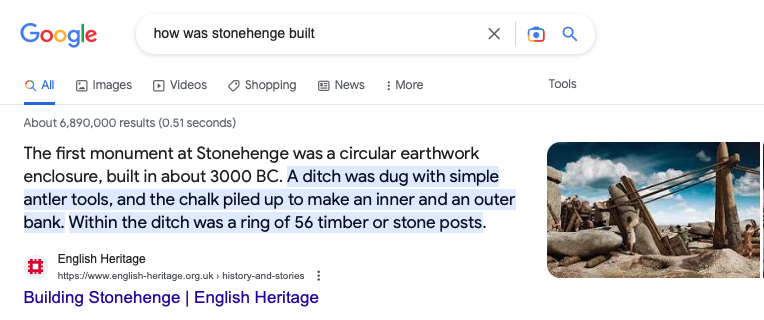
https://www.english-heritage.org.uk/visit/places/stonehenge/history-and-stories/building-stonehenge/#:~:text=The%20first%20monument%20at%20Stonehenge,56%20timber%20or%20stone%20posts
The above URL is NOT the URL to use in a reference list. The URL needs to be truncated back to the forward slash before the #
The following URL is also NOT the correct URL to use:
https://www.google.com/search?q=how+was+stonehenge+built&rlz=1C5CHFA_enAU1045AU1045&oq=how+was+stonehenge+built&aqs=chrome.0.35i39j0i67i650j0i512l2j0i10i22i30j0i22i30l5.3560j0j7&sourceid=chrome&ie=UTF-8
The correct URL is:
https://www.english-heritage.org.uk/visit/places/stonehenge/history-and-stories/building-stonehenge
URL for images.
Use the URL of the webpage the image comes from, NOT the Google search URL.
References
McAdoo, T. (2023, April 7). How to cite ChatGPT. APA Style. https://apastyle.apa.org/blog/how-to-cite-chatgpt