
Learning Intentions
By the end of the session you should be able to:
- Explain why we need to reference
- Identify APA 7 as the referencing system used at MLC
- Identify the required elements of a reference and create a correctly formated reference list
- Use in-text citations
- Use tools to create references including Citefast
The importance of referencing
What is referencing?
Referencing is “the system you use … to acknowledge other people’s ideas or research” in your work (University of Southern Queensland, n.d.), that includes in-text citations and an end reference list. It indicates to your readers the material you have used from another source of information.
The referencing system you use sets out instructions for how to format the information you need to include in your references.
Some other words you might come across:
- Bibliography
- Cite
- Citation
Types of referencing systems include:
- Chicago
- Harvard
- MLA
- APA
• Give credit to authors and creators for their intellectual property
• Demonstrate academic honesty and ethical behaviour
• Allow readers to locate and consult the original sources
• Support claims, arguments, and evidence presented in the work to give your work credibility
• Demonstrate depth and breadth of research
• Helps to avoid plagiarism and it’s consequences
(Reasons for referencing, n.d.)
- Adhere to MLC’s Assessment Policy
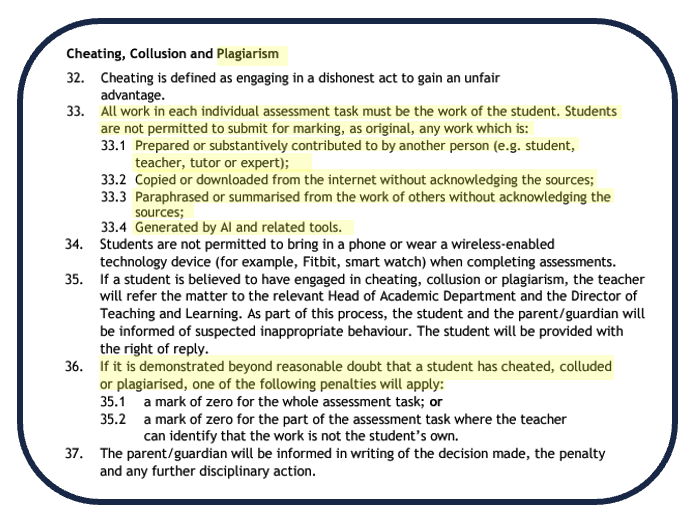
Here is an extract from MLC’s Assessment Policy. Pay particular attention to section 33.
- Plus it’s the law
Under the Copyright Act 1968, “the Law enables the person who created the material to have rights over what happens to it” (Australian Catholic University, n.d.) and a creator has the moral right to have their work treated with respect and attributed to them as the owner of the work (Copyright Agency, 2022).
APA basics
The referencing system most used at MLC is APA 7 – American Psychological Association (APA) – version 7.
A referencing system provides guidelines for citing various sources of information in a consistent manner. All reference lists contain the following details about each source that is used in your work:
The Four Key Components of APA 7:
-
-
- Author(s): The person(s) or organisation(s) responsible for creating the work
- Date: The year of publication or creation
- Title: The title of the work being cited
- Source origin: The publication or retrieval details for the work (i.e. publisher, volume and issue numbers, or URL)
-
Examples of common formats:
-
- Books:
Author, A. A. (Year). Title of book. Publisher.
Crilly, A. J. (2007). 50 mathematical ideas you really need to know. Quercus.
-
- Journal articles:
Author, A. A. (Year). Title of article. Title of Journal, volume(issue), pages.
Note: for journal articles accessed digitally, include the DOI (digital object identifier) if there is one.
Moore, K. (2023). Ancient Leaf Patterns. Natural History, 131(8), 6.
Sosteric, M., & Ratkovic, G. (2022). It takes a village: Advancing attachment theory and recovering the roots of human health with the Circle of Seven Essential Needs. Aotearoa New Zealand Social Work Review, 34(1), 113–127. https://doi.org/10.11157/anzswj-vol34iss1id887
-
- Websites:
Author, A. A. (Year, Month Day). Title of web page. Site name. URL
Ghose, T. (2023, March 1). What is the Fibonacci sequence? Live Science. https://www.livescience.com/37470-fibonacci-sequence.html
-
- Online Videos:
Name of account. (Specific date). Title of the video [Video]. Site name. URL.
Society for Research in Child Development. (2020, January 23). John Bowlby and Attachment Theory [Video]. YouTube. https://www.youtube.com/watch?v=Exf_rR1NnNs
In-text citations vs. reference list entries
-
- In-text citations: Brief citations within the text that refer to a specific source; includes the author’s last name, the publication year, and the page number(s) if applicable, e.g. (Smith, 2020, p. 12).
- Reference list entries: Complete citations for each source mentioned in the text, listed alphabetically at the end of the paper; provides all necessary information for readers to locate and consult the original sources.
The format may change slightly depending on the source type.
The MLC Referencing Guide (2024) gives you the format for most common source types.
Other basic formatting rules:
Organise the reference list in alphabetical order by the author’s surname.
Author’s surname comes first, followed by a comma then their initials.
If the item has no author, then use the title first.
Punctuation is important used –
The date of publication us in brackets (If there is no publication date use n.d. in it’s place).
Fullstops are used between each element of information (except not at the end of a URL).
Use a space after each punctuation mark.
Titles are in italics. If it’s an article in a journal, newspaper or magazine, the title of the publication is italicised, not the title of the article.
If your citation goes over a line, you must use a hanging indent. (CLICK HERE on how to create a hanging indent in Word)
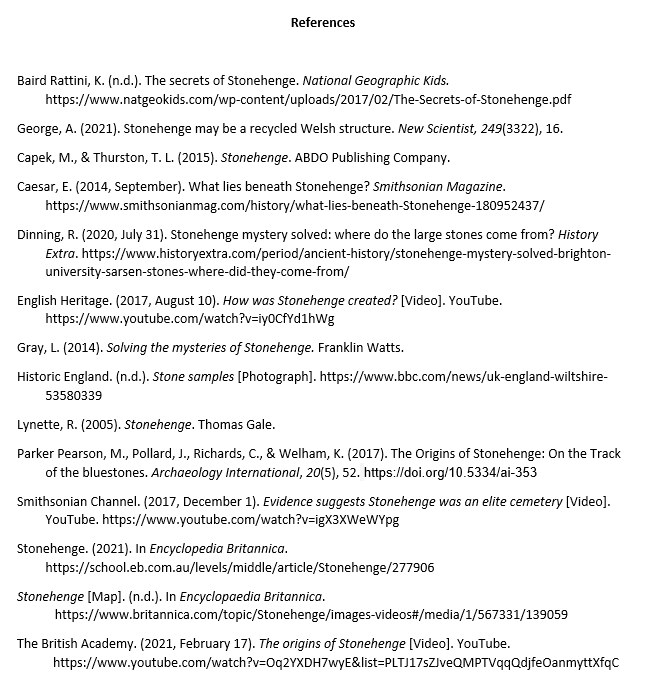
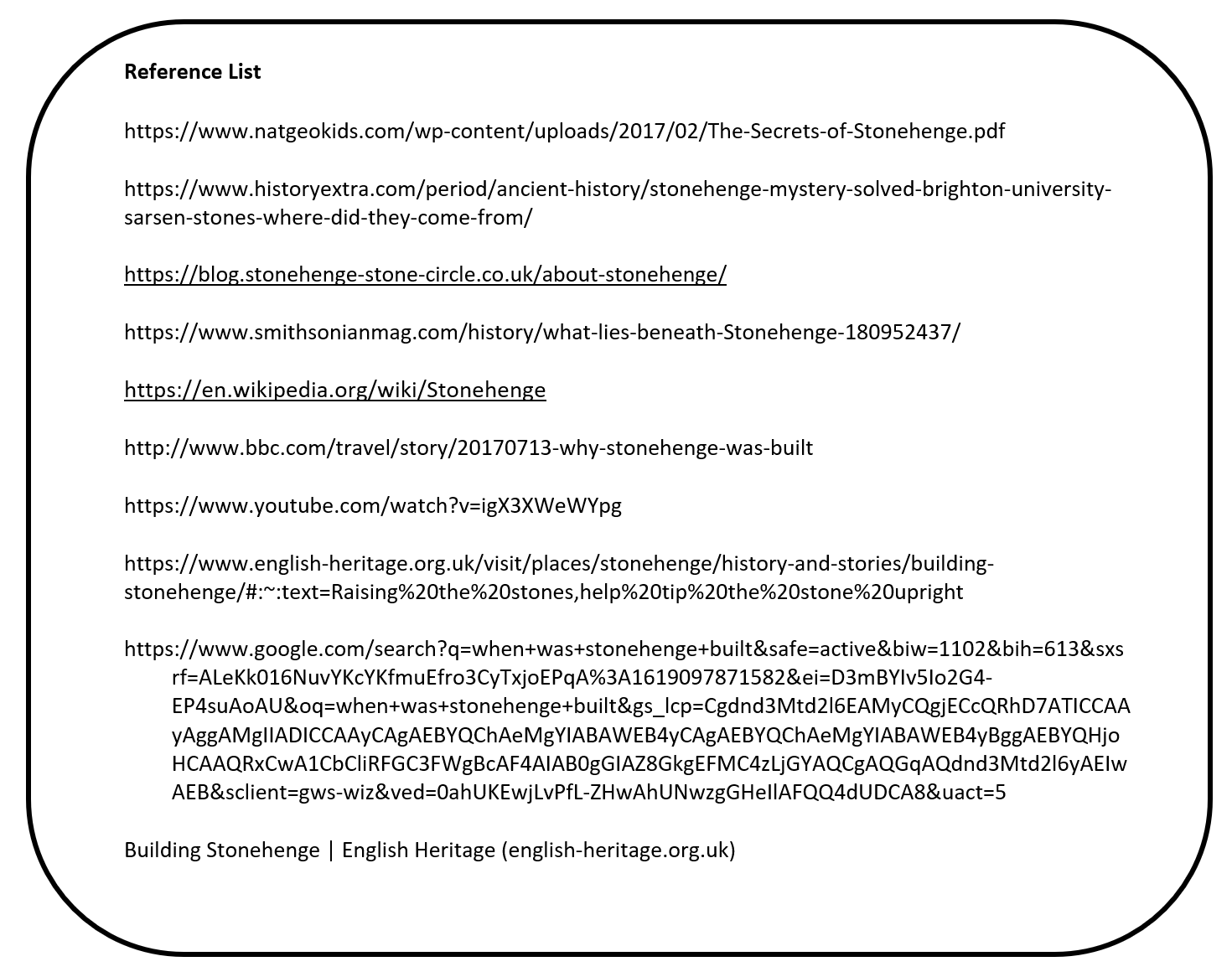
Example Reference List:
Correct format
Incorrect format
In-text citations
In-text citations are required whenever you use the ideas or words of someone else in your own work as either as a direct quote or paraphrase.
Note: In-text citations do form part of the word count.
Watch the following video to find out about in-text citations.
Direct Quotes
This is where you use the exact words of someone else’s work and then cite it.
Citing requires you to include the author, year of publication and page or paragraph number (preceded with p. or para. if possible).
Below are the different ways you could include quotes in your work.
Parenthetical examples:
1. With an introductory sentence
Within a decade a significant proportion of jobs that exist today in Australia will be replaced by automation: “21% of physical jobs and 28% of location-based jobs will disappear by 2030” (Higgins et al, 2021, p.13).
2. Incorporated into your own sentence
Due to automation, artificial intelligence and physical robotics, it is predicted that “21% of physical jobs and 28% of location-based jobs will disappear” in Australia by 2030 (Higgins et al, 2021, p.13).
Narrative example (the author is part of your sentence)
3. With an introductory phrase
A recent study by Higgins et al (2021, p.13) predicts that in Australia “21% of physical jobs and 28% of location-based jobs will disappear by 2030”.
Click here for more on direct quotes and how to cite them (from scribber.com)
Paraphrasing
Paraphrasing is putting someone’s else’s words into your own words and is an alternative to a direct quote. It is preferred to direct quotes as it allows you to demonstrate that you understand the idea you are citing. In this way paraphrasing is more than a simple rearrangement of words, it is a substantial change to the structure of the text.
To avoid plagiarism when paraphrasing, you must cite your source with an in-text citation (Scribbr, 2022).
Click here for more on how to paraphrase and how to cite a paraphrase (from scribber.com)
Citing ChatGPT
What about citing ChatGPT?
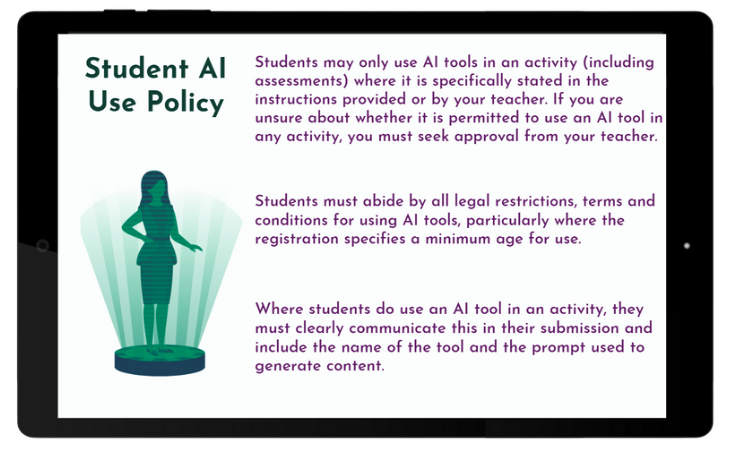
How to cite AI generative tools?
Note: The following is related to the use of ChatGPT for research-based learning, i.e. using ChatGPT to gather information, answer an inquiry focus question. For this type of use and any other use, teachers may also want you to submit a declaration where you provide details on how the AI tool has been used in the assignment (i.e. idea generation, research, structure, writing). See the example from Curtin University HERE.
In addition to academic integrity issues, when referencing ChatGPT there is an absence of traditional authorship and publication information with AI-generated content, making citing it in academic work rather complex.
ChatGPT – As responses from a ChatGPT “chat” is unretrievable, it is currently widely considered to reference ChatGPT as personal communication. However, as the communication isn’t with a person, according to APA (McAdoo, 2023) it should be treated as though the creator of the AI model is the author, and citing it like software is considered appropriate.
At MLC? As at June, 2023
The expectation for referencing ChatGPT and other AI tools is evolving, so what it recommended below is subject to change.
Year 7 & 8 – Include an end-text reference list & provide the share link from the AI tool after the referencing list.
Referencing Format:
Author of AI Model used. (Year of AI model used). Prompt Description. Name of AI model used (Version). URL of the sharelink of the of the AI model used.
Example:
OpenAI. (2023). Prompt, ‘How was Stonehenge built?’ ChatGPT (May 24 version). https://chat.openai.com/share/483cb175-4411-477e-88cf-6dd4ac961177
Year 9 -12
1. Include an in-text reference. Example:
When prompted with “What are man-made causes of salinity in agricultural land in Australia?” the ChatGPT-generated text indicated that there are several man-made causes including land clearing and inefficient irrigation and soil management practices (OpenAI, 2023).
2. Include the end-text reference
Open AI. (2023). Prompt, “What are man-made causes of salinity in agricultural land in Australia?” ChatGPT (May 24 version). https://chat.openai.com/share/4b816d37-bdd9-46b0-9645-eb5777ae7910
Important
Not citing the use of ChatGPT or using it when it’s not permitted could be considered cheating. You should make yourself aware of the MLC Assessment policy.
Citing AI-generated content is complex and you need to verify the accuracy of AI-generated content using reliable sources of information as AI models sometimes produce inaccurate responses.
It is also important to you are aware of the ethical use of AI-generated content and its impact on intellectual property rights. Your teachers may discuss this with you further.
Reference:
Where to get further help
Where can I get help with my referencing?
From the Library
- MLC Referencing Guide (2024) (This can be downloaded and stored on your device)
- Teacher Librarians
- Use the citation tools in the Online Catalogue and library databases
APA website
Scribbr website
How to Cite in APA Format (7th edition) | Guide (scribbr.com)
Free citation generators
Scribbr and Citefast are two that you can create a free account for so you can save and create multiple reference lists.
*Important Note: Be aware of the pros and cons of using citation generators.
Australian Catholic University. (n.d.). Copyright basics. https://library.acu.edu.au/copyright/copyright-basics
Copyright Agency. (2022). Moral rights. https://www.copyright.com.au/about-copyright/moral-rights/
Higgins, S., Meena, S., & Gownder, J.P. (2021, February 22). Future Jobs: Australia’s Automation Dividends And Deficits, 2020 To 2030. https://www.parliament.nsw.gov.au/lcdocs/submissions/70815/0044%20Forrester%20Research%20Inc.pdf
Leeds University Library. (2009). References and citations explained [PowerPoint slides]. http://skills.library.leeds.ac.uk/lecturer/referencing/workshops/referencesandcitationsexplai ned.ppt
Reasons for referencing. (n.d.). http://www.hawkerc.act.edu.au/__data/assets/pdf_file/0007/268891/3_REASONS_FOR_REFERENCING.pdf
Scribbr. (2020, November 3). APA 7th Edition: The Basics of APA In-text Citations [Video]. YouTube. https://youtu.be/opp259YvaoE
University of Southern Queensland. (n.d.). Referencing. http://www.usq.edu.au/extrafiles/ltsu/templates/ltsu_templates/referencing.htm
Your feedback is appreciated