
Year 8 Economics & Business
Government Intervention in the Economy
Last updated 5 September 2019
A market economy is where most of the resources are owned and controlled by individuals and the buyers and sellers are allowed to trade quite freely without laws and regulations from the government .
Some people believe that economies and businesses work best when the government does not become involved but sometimes there are good reasons for the government to intervene.
These can include:


Law and justice
The government provides laws that allow people to buy and sell using a set of rules that is fair for everyone. Australian Consumer Law protects consumers from businesses that could try to cheat them

Welfare
Welfare payments help those who are not able to earn an income.
Providing Infrastructure
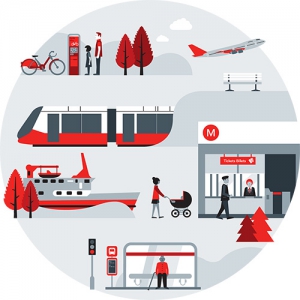
It is a major responsibility of the government to provide roads, railways, ports and ways to communicate. In the past, energy supplies have also been provided by the government.

Managing the Economy
Governments use their own budgets to influence the flow of money in the economy. When there is not enough money, the economy will not grow so they government may spend more money than usual.

Wages and Employee Relations
Governments pass laws to make sure the market is fair for workers. The laws include areas like minimum wages and working conditions.

Providing Goods & Services
The government provides things like health, education, emergency services and defence to make sure everyone has access or because businesses couldn’t make a profit from providing them.

Planning and the Environment
The government makes laws to control the type of buildings and other developments to make sure all buildings are safe and not dangerous. They also make laws to protect the environment.
The Task
Your task is compare the success of government intervention in the economy between Australia and a Least Economically Developed Country (LEDC). This means looking at not just what laws and regulations exist in the country but also if the government is able to enforce those laws.
You will need to select a LEDC country from the United Nation Official List.
Afghanistan | Bangladesh | Cambodia | Chad | Haiti | Solomon Islands | Zambia
The information you need to include in your presentation:
- The location of your LEDC in the world
- Key indicators of development
- Urban vs rural population Britannica School database
- Life expectancy at birth Britannica School database
- Number of years spent at school Our World in Data
- Major occupations and the percentage of people employed in those occupations (Labour Force – by occupation) CIA World Factbook
Compare Australia to your country using the following categories (where possible):
- Welfare
- Provision of infrastructure
- e.g. roads, communication
- Wages and employee relations
- Minimum wage
- Superannuation
- Child labour laws
- Occupational health and safety laws
- Provision of goods and services
- Compulsory education
- Health care
- Other relevant areas that might have an impact
- Marriage laws
Overall how do the living conditions compare to Australia using this information and what part has government intervention played?
You will also need to submit a correctly formatted bibliography. You could use Citefast for this.

Extension
Investigate the reasons why the government of your LEDC has not been successful. For example, your country could have experienced a natural disaster or been involved in a conflict.
Recording your information
Record the information you find using this note making sheet
Click on the three … to download a copy of this document to your device.
Presenting your information
This information will be presented to the class using a presentation tool like:

Powerpoint
 Keynote

Australia
Welfare
Australian Government. Department of Human Services. (n.d.). Centrelink. Retrieved from https://www.humanservices.gov.au/individuals/centrelink
Provision of Infrastructure
International Telecommunications Union. (n.d.). Statistics. Retrieved from https://www.itu.int/en/ITU-D/Statistics/Pages/stat/default.aspx
This page gives information in an Excel spreadsheet about how many people in each country have access to telephones and internet technology. You will need to download the spreadsheets to view the data.
Roads Australia. (2019). Retrieved from https://www.roads.org.au/
Towards the bottom of the page are some statistics about the road network in Australia that will be useful.
Telstra. (n.d.). Coverage network. Retrieved from https://www.telstra.com.au/coverage-networks
Wages and employee relations
FairWorkGovAu. (2016, September 9). How minimum wages work [Video file]. Retrieved from https://www.youtube.com/watch?v=7_b2FLPLMS8
FairWorkGovAu. (2013, October 15). Know your workplace rights [Video file]. Retrieved from https://www.youtube.com/watch?v=LaYr2EfnK4w
Government of Western Australia. Department of Mines, Industry Regulation and Safety. (2018). When children can work in Western Australia. Retrieved from https://www.commerce.wa.gov.au/labour-relations/when-children-can-work-western-australia
Safe Work Australia. (2019). Retrieved from https://www.safeworkaustralia.gov.au/
Provision of goods and services
Australian Government. Department of Health. (2019). The Australian health system. Retrieved from https://www.health.gov.au/about-us/the-australian-health-system
Government of Western Australia. Department of Education. (n.d.). Schooling. Retrieved from https://www.education.wa.edu.au/schooling
Other relevant areas
Australian Government. Attorney General’s Department. (n.d.). Getting married. Retrieved from https://www.ag.gov.au/FamiliesAndMarriage/Marriage/Pages/Getting-married.aspx#getting_married_aust
China
You will need to explain the difference between Australia’s and China’s economies.
Australia is a mixed economy.
China is also a mixed economy however has been moving from a planned or command economy.
Use the following articles to explain to the class the difference.
Centre for European Studies. (n.d.). Handout B: three major economic systems and their features. Retrieved from https://carleton.ca/ces/eulearning/wp-content/uploads/Handout-B-revised.pdf
The four types of economies. (n.d.). Retrieved from https://www.intelligenteconomist.com/types-of-economies/
Welfare
China Labour Bulletin. (2019). China’s social security system. Retrieved from https://clb.org.hk/content/china%E2%80%99s-social-security-system
This is quite detailed but does talk about the way pensions work and the equivalent of superannuation in China.
HROne. (2018). Guide to China’s social security system – who pays what. Retrieved from https://www.hrone.com/guide-chinas-social-security-system-pays/
Provision of Infrastructure
China. (2019). In Encyclopædia Britannica. Retrieved from Britannica School database.
International Telecommunications Union. (n.d.). Statistics. Retrieved from https://www.itu.int/en/ITU-D/Statistics/Pages/stat/default.aspx
This page gives information in an Excel spreadsheet about how many people in each country have access to telephones and internet technology. You will need to download the spreadsheets to view the data.
Is China’s infrastructure boom past its peak? (2018, September 20). the Economist. Retrieved from https://www.economist.com/china/2018/09/20/is-chinas-infrastructure-boom-past-its-peak
You only need to read the first paragraph of this article.
Wages and employee relations
China Labour Bulletin. (2019). China sees progress in tackling child labour but problems remain. Retrieved from https://clb.org.hk/content/china-sees-progress-tackling-child-labour-problems-remain
China Labour Bulletin. (2019). Work safety. Retrieved from https://clb.org.hk/content/work-safety
Koty, A.C., & Zhou, Q. (2019). Minimum wages in China 2019. Retrieved from https://www.china-briefing.com/news/minimum-wages-china-2019/
Zuo, M. (2016, November 22). Under 16 and working 16 hour a days. South China Morning Post. Retrieved from https://www.scmp.com/news/china/society/article/2048231/clothing-factories-eastern-china-import-child-labour-migrant
Provision of goods and services
Crean, S. (2010). China. England: Wayland.
InterNations Go! (2019). Healthcare in China. Retrieved from https://www.internations.org/go/moving-to-china/healthcare
InterNations Go! (2019). Education in China. Retrieved from https://www.internations.org/go/moving-to-china/education
Other relevant areas
References
Bag of money [Image]. (n.d.). Retrieved from http://www.pngmart.com/image/28749
Consumer protection [Image]. (n.d.). Retrieved from https://www.cleanpng.com/png-consumer-protection-stock-photography-royalty-free-1339736/preview.html
Darlington, R., Mraz, J., Smithies, G., & Richardson, M. (2018). Jacaranda Humanities and Social Sciences 8 for Western Australia. Milton, QLD: Jacaranda.
Digital economy [Image]. (n.d.). Retrieved from https://www.toppr.com/guides/business-environment/emerging-trends-in-business/digital-economy/
Family silhouette [Image]. (n.d.). Retrieved from https://www.kissclipart.com/family-and-society-clipart-family-clip-art-1rawbc/
Healthcare [Image]. (n.d.). Retrieved from https://icon-library.net/icon/icon-healthcare-8.html
Kwik. (n.d.). Planning [Image]. Retrieved from https://www.cleanpng.com/png-checklist-digital-estate-planning-marketing-requir-458960/
Transport [Image]. (n.d.). Retrieved from https://www.serco.com/uk/sector-expertise/transport